


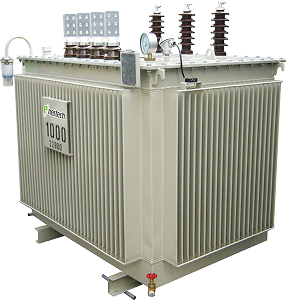
hybrid transformer
Hybrid Transformer
An all-in-one transformer that integrates power transformation and harmonic mitigation functions. Developed as an industry-first solution through joint R&D with KEPCO’s five power generation subsidiaries, it is certified under the New Excellent Technology (NET) and Green Technology.


Growing Harmonic Damage
As nonlinear loads such as LED lighting, inverters, and EV chargers continue to increase, harmonic-related equipment damage is becoming more widespread.
Harmonic mitigation is essential to prevent transformer failures, reduce losses, and improve energy efficiency.
Higher Transformer Losses and Rising Costs
Harmonics negatively affect electrical equipment by lowering efficiency and increasing temperature rise.
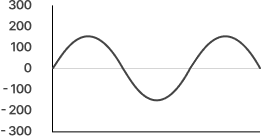
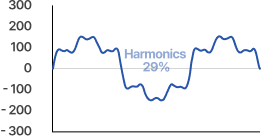
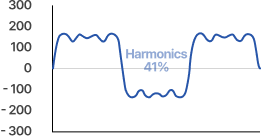
Harmonics do not merely raise electricity bills;
they continuously increase the total cost of ownership (TCO) of electrical assets.
-

Increased Energy Loss
Electricity costs increase in proportion to the additional losses (△P) caused by harmonics.
- Annual additional cost = △P (kW) × 24 h × 365 days × electricity unit rate
-

Transformer Derating
When harmonics are present, a transformer’s effective usable capacity can decrease by more than 20%.
- Example : Even with a 1,000 kVA transformer installed, severe harmonic conditions may limit usable capacity to around 800 kVA, reducing utilization efficiency by more than 20%.
-

Shorter Expected Life
For transformer insulation systems, expected life is reduced by approximately 50% for every 8–10°C increase in temperature.
- Temperature rise caused by harmonics can shorten replacement cycles from 25 years to 12.5 years or less, more than doubling long-term replacement costs.
Degraded Power Quality and Higher Losses
Harmonics are a major cause of poor power quality and rapidly increase electrical losses.
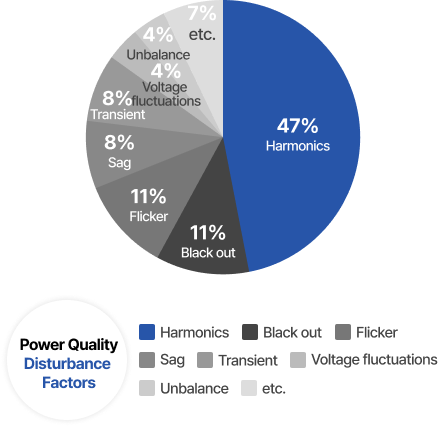
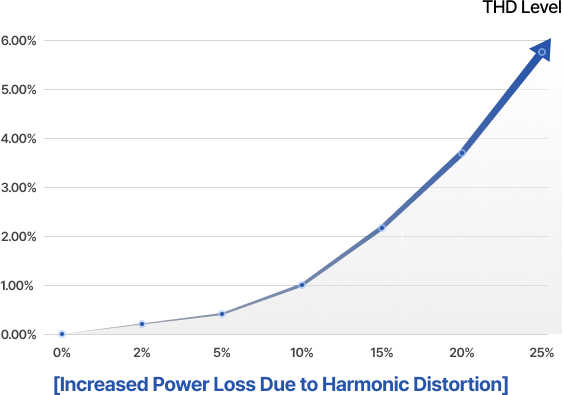
These losses stem from three main mechanisms inside the transformer.
-
Eddy Current Loss, 𝑷𝑬𝑪
Harmonic currents sharply increase eddy current loss in proportion to the square of frequency.

- 𝑷𝑬𝑪 : Eddy current loss at rated frequency
- ℎ : Harmonic order(ℎ = 3, 5, 7, 9 ...)
- 𝐼ℎ : Harmonic current component of each order
-
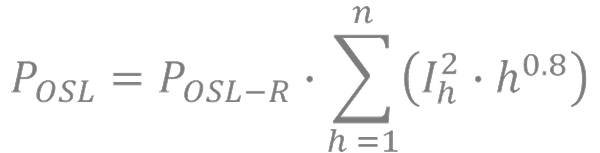
Stray Load Loss, 𝑷𝑶𝑺𝑳
Losses occurring in the transformer tank or structural members, increasing approximately with frequency to the power of 0.8.
-
Ohmic Loss, 𝑷𝒅𝒄
Losses caused by increased effective conductor resistance due to the skin effect.
Examples of Harmonic Damage
Harmonics can cause many forms of damage in power systems and electrical equipment, including increased loss, overheating, noise, and malfunction.
-

Capacitor failure -

Transformer failure -

Overcurrent / busbar damage -

MOF failure -

Motor overheating / burnout
-
Transformer
Increased iron and copper losses,
overheating, increased noise,
reduced capacity,
insulation breakdown -
Rotating Equipment
Overheating
Reduced efficiency
Shortened equipment life
Non-uniform torque
Torque pulsation and vibration -
Wires and Conductors
Overheating
Corona discharge
Neutral overcurrent
Reduced current-carrying capacity
Insulation breakdown
Skin effect -
Power Capacitors
Overheating
Excessive resonance
Overcurrent
Overvoltage
Insulation failure or explosion -
Power Converters
Sudden shutdown
Inaccurate measurements
Generation of non-integer harmonics
Malfunctions
Frequent component failures -
Circuit Breakers, others
Reduced current-carrying capacity
Noise and vibration
Accelerated lifespan degradation
Lower power factor
Reduced fuse capacity
Signal and communication failures
Tightening Harmonic Management Standards
Harmonic control standards are being enforced worldwide to prevent electrical damage caused by harmonics.
IEC 61000 Harmonic Standard
Table. Allowable current ampacity by equipment
| Harmonics (n) |
Equipment Classification | |||
|---|---|---|---|---|
| Balanced 3-phase equipment, Tools, sound equipment, Household appliances (A) |
Portable device, Arc welding machine (A) |
Lighting equipment (A) |
PC, Monitor, TV, Refrigerator, Freezer (Under 600W) (A) |
|
| Odd Harmonics | ||||
| 3 | 2.30 | 3.45 | 30 X Power factor |
2.30 |
| 5 | 1.14 | 1.71 | 10 | 1.14 |
| 7 | 0.77 | 1.155 | 7 | 0.77 |
| 9 | 0.40 | 0.60 | 5 | 0.40 |
| 11 | 0.33 | 0.495 | 3 | 0.33 |
| 13 | 0.21 | 0.315 | 3 | 0.21 |
| 15 ≤ n ≤ 39 | 0.15 × 15/n | 0.225 × 15/n | 3 | 0.15 × 15/n |
| Even Harmonics | ||||
| 2 | 1.08 | 1.62 | 2 | - |
| 4 | 0.43 | 0.645 | - | - |
| 6 | 0.30 | 0.45 | - | - |
| 8 ≤ n ≤ 40 | 0.23 × 8/n | 0.345 × 8/n | - | - |
IEEE Std. 519 Standard for Harmonic
Table 1—Voltage distortion limits
| Bus voltage V at PCC | Individual harmonic (%) | Total harmonic distortion THD (%) |
|---|---|---|
| V ≤ 1.0 kV | 5.0 | 8.0 |
| 1 kV < V ≤ 69 kV | 3.0 | 5.0 |
| 69 kV < V ≤ 161 kV | 1.5 | 2.5 |
| 161 kV < V | 1.0 | 1.5a |
Table 2—Current distortion limits for systems rated 120 V through 69 kV
| Maximum harmonic current distortion in percent of IL | ||||||
|---|---|---|---|---|---|---|
| Individual harmonic order (odd harmonics)a,b | ||||||
| Isc/IL | 3 ≤ h < 11 | 11 ≤ h < 17 | 17 ≤ h < 23 | 23 ≤ h < 35 | 35 ≤ h < 50 | TDD |
| < 20c | 4.0 | 2.0 | 1.5 | 0.6 | 0.3 | 5.0 |
| 20 < 50 | 7.0 | 3.5 | 2.5 | 1.0 | 0.5 | 8.0 |
| 50 < 100 | 10.0 | 4.5 | 4.0 | 1.5 | 0.7 | 12.0 |
| 100 < 1000 | 12.0 | 5.5 | 5.0 | 2.0 | 1.0 | 15.0 |
| > 1000 | 15.0 | 7.0 | 6.0 | 2.5 | 1.4 | 20.0 |
b Current distortions that result in a dc offset, e.g., half-wave converters, are not allowed.
c All power generation equipment is limited to these values of current distortion, regardless of actual Isc/IL.
where
Isc = maximum short-circuit current at PCC
IL = maximum demand load current (fundamental frequency component) at the PCC under normal load operating conditions